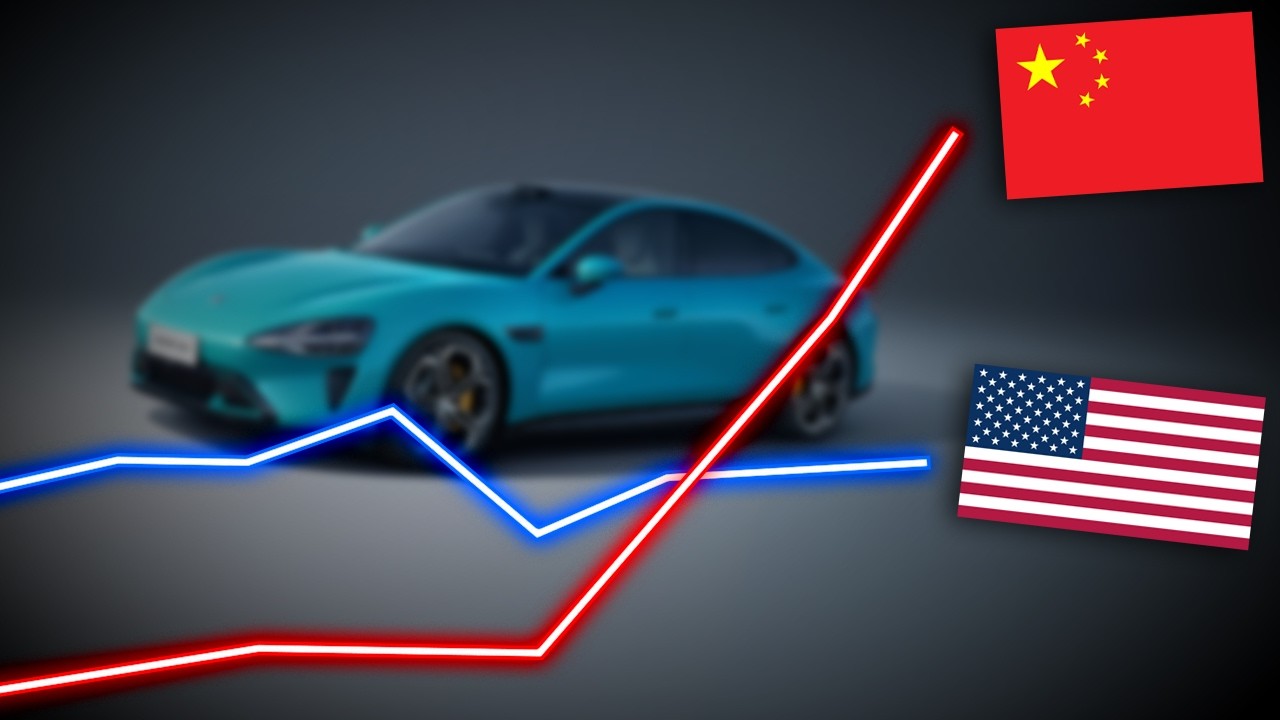
00:14:20
The Xiaomi SU7: A Glimpse of What We're Missing — And Why
A detailed hands-on review of a leading Chinese EV highlights its advanced technology, value, and the complex protectionist policies keeping it out of Western markets. This case study underscores a critical debate about competition, innovation, and the future of the global auto industry.
Core Insight
The Xiaomi SU7 exemplifies China's rapid ascent in high-end EV manufacturing, offering premium features, sophisticated software, and build quality that rivals cars costing nearly twice its price. Its absence from markets like the U.S., due to high tariffs, raises questions about whether protectionism stifles domestic innovation more than it protects it.
The Debate Around Chinese EVs
Public perception of Chinese electric vehicles has undergone a significant shift. Just a few years ago, common criticisms focused on safety concerns and doubts about reported performance data. Over time, as evidence of their quality and sales dominance—exemplified by BYD surpassing Tesla—has become undeniable, the narrative has shifted to widespread acceptance of China's leading role in the EV sector.
This evolution makes the current reality stark: many of the most compelling and technologically advanced EVs are manufactured in China but are largely inaccessible to consumers in markets like the United States due to substantial trade barriers.
A Closer Look at the Xiaomi SU7
The Xiaomi SU7 is a potent symbol of this new reality. Created by the Chinese electronics giant Xiaomi in approximately three years—a timeline that contrasts sharply with other tech companies' abandoned automotive projects—the SU7 has quickly established itself as a top-tier electric sedan.
Design and Build Quality
The car's design incorporates familiar aesthetic cues from established premium brands like Porsche, McLaren, and Mercedes-Benz, but synthesizes them into a cohesive and attractive package. More importantly, the build quality defies its price point. Reviewers note exceptional interior materials, effective sound dampening that creates a quiet cabin, and a general feeling of solidity that compares favorably with luxury vehicles.
Software and Ecosystem Integration
Where the SU7 (and many Chinese EVs) truly distinguishes itself is in software integration and user experience. The system is notably smooth and intuitive, drawing comparisons to what an "Apple Car" might have offered. Key features include:
- Seamless Phone Integration: Full wireless screen mirroring from a Xiaomi smartphone to the car's central display.
- Intelligent Audio Routing: A dedicated speaker in the driver's headrest plays navigation instructions without interrupting music for all other passengers—a solution to a common annoyance in modern cars.
- Regular Over-the-Air Updates: A pace of continuous software improvement and feature additions that has reportedly slowed among some Western EV makers.
The Tariff Wall and the "Catfish" Theory
The primary barrier to cars like the SU7 in the U.S. is a 100% tariff, effectively doubling the cost and removing its value proposition. Circumventing this via personal import is illegal, carrying risks of fines and prosecution.
This protectionist approach contrasts with a strategy China itself previously employed. By allowing Tesla to operate a wholly-owned factory in Shanghai—an exception to its usual joint-venture rules—China introduced a "catfish" into its domestic "koi pond." The intense competition from Tesla is widely credited with accelerating the development and competitiveness of local Chinese EV companies.
The argument follows that by blocking competitive products like the SU7, Western markets may be sheltering their domestic automakers from the very pressure needed to drive rapid innovation and consumer-friendly pricing. The Ford CEO's personal, extended testing of the SU7 and his subsequent public praise for it underscores the vehicle's impact as a benchmark.
"The only good part about capitalist free market economies is the competition. If you get rid of that part, you only have the downsides... They get none of the diversity of products competing for their benefit."
The Strategic Dilemma and Global Implications
The situation presents a complex dilemma. On one hand, open competition could lower prices, accelerate innovation, and provide consumers with better products. On the other, a sudden influx of competitively priced, high-quality foreign vehicles could severely disrupt established auto industries, which are major employers, particularly in regions like Europe.
The reviewer's conclusion that "we are not cooked yet" hinges on the fact that the SU7's brilliance lies not in unmatchable proprietary technology, but in excellent execution and integration of available tech at an aggressive price point. This is theoretically replicable.
However, the question remains whether domestic industries, without the immediate pressure of such direct competition, will be motivated or able to replicate this level of value. The risk is a paradox: protectionism intended to shield a home industry may ultimately leave it less competitive on the global stage, as the rest of the world increasingly adopts the advanced, affordable products from manufacturers who are competing at the highest level.
Conclusion: A Preview of the Automotive Future
The Xiaomi SU7 serves as a powerful case study. It demonstrates that China's manufacturing evolution into high-value, technology-integrated products is mature and formidable. For consumers and policymakers in Western markets, it represents both a missed opportunity and a strategic challenge.
The central tension is between short-term economic protection and long-term innovative vitality. Finding a path that fosters domestic capability while embracing the competitive pressures of a global market may be the defining task for the auto industry in the coming decade. As one reviewer put it, the SU7 feels like a $75,000 car sold for $42,000—and that disparity is ultimately a political and economic reality, not just an automotive one.
 Why China's Semiconductor Industry is Confidently Pushing Forward Without Nvidia Chips
 How to Win When AI Changes Everything: Key Insights from Sam Altman
 Unlock Breakthrough Growth: The Peak Performance Equation Revealed
 The Unconventional Genius Behind Linux: Linus Torvalds on Quiet Focus and Engineering Excellence
 How Chinese Colour Theory Revolutionized My Artistic Approach
 Is China Heading Toward a "Lost Decades" Scenario? Deflation, Property Crisis, and Consumer Gloom
 Mastering Social Media Marketing: Your Comprehensive Guide to Building Brands and Boosting Sales
 How to Change Minds: Why Facts Alone Fail and What Actually Works
 Cloudflare Outage Reveals Fragility of Modern Internet Infrastructure
 David Heinemeier Hansson: Programming, Ruby on Rails, and Life Beyond Code
 Sam Altman Unveils GPT-5: Capabilities, Future of AI, and Societal Impact

 Building a True MVP: How to Launch Fast and Validate Your Idea
 Inside OpenAI's $500 Billion Stargate: The AI Megafactory Reshaping Tech and Society
 China's Mountain-Split Bridge: Engineering Triumph in Guizhou's Highlands
 Sam Altman Unveils GPT-4's Breakthroughs and AGI Roadmap
 The Xiaomi SU7: A Glimpse of What We're Missing — And Why
Europe's Strategic Blind Spot: Why China Views the Continent as Invisible
The Xiaomi SU7: A Glimpse of What We're Missing — And Why
Europe's Strategic Blind Spot: Why China Views the Continent as Invisible
 Does OpenAI's Sora Disrupt Meta? Analyzing the Shift in AI-Driven Content Creation