00:15:29
China's Mountain-Split Bridge: Engineering Triumph in Guizhou's Highlands
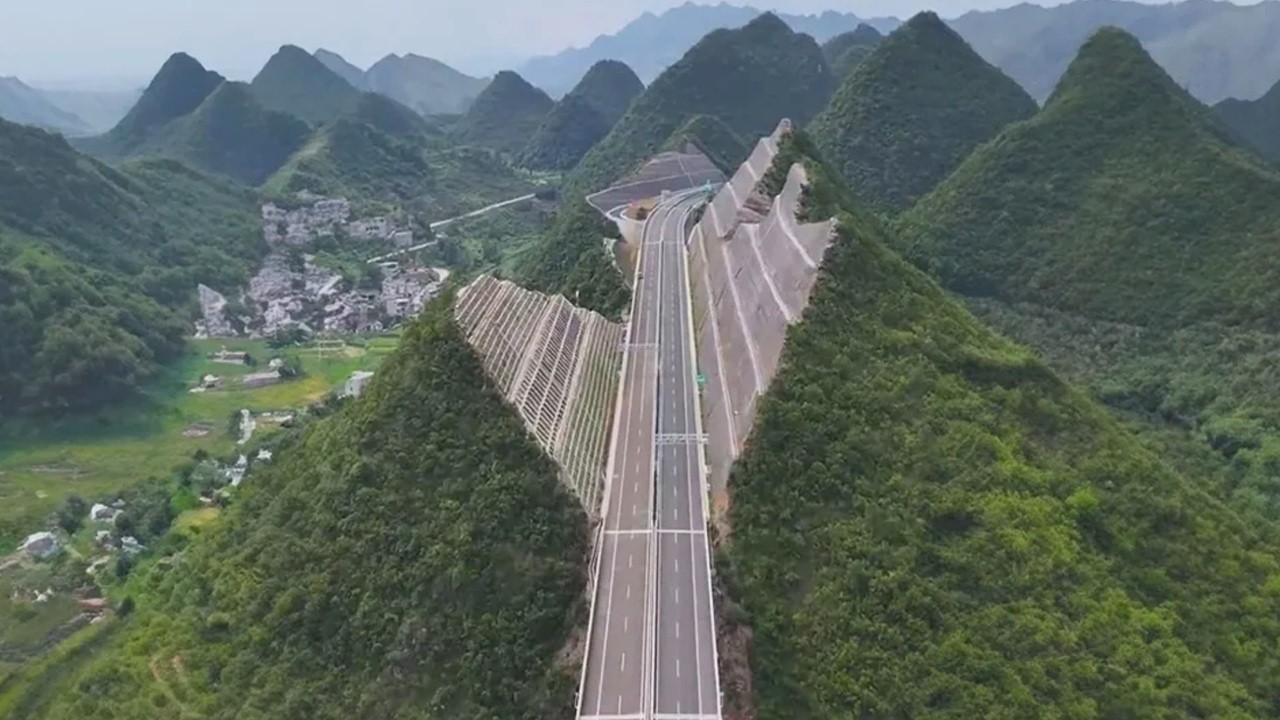
Soaring 625 meters above the Huajiang Canyon in Guizhou Province, the newly opened Huajiang Canyon Bridge (HuaJiang Bridge) is now the world's highest bridge. This engineering marvel reduces a treacherous 2-hour mountain drive to a mere 2-minute crossing, transforming connectivity in one of China's most challenging landscapes.
The Challenge of Guizhou's Terrain
Guizhou Province, often called the "Switzerland of China" for its stunning natural beauty, presents significant geographical obstacles. Over 90% of its land is covered by mountains and hills, historically isolating communities and hindering development. The local saying "no 3 ft of level ground" underscores the difficulty of movement.
To overcome this, China has invested heavily in infrastructure, including the Guiyang Longdongbao International Airport, high-speed rail, expressways, and an astonishing network of over 32,000 bridges. The Huajiang Canyon Bridge represents the pinnacle of these efforts.
Engineering the Impossible: Splitting Mountains and Spanning Canyons
The bridge is a key component of the Guizhou S57 Expressway, a 150 km highway cutting through mountainous terrain. Constructing this route required literally splitting a mountain in half. Engineers used explosives and massive drills to create a precise V-shaped cut in the rock, enabling the highway's path.
The bridge itself is a suspension design chosen for its stability in rocky terrain. Key specifications include:
- Total Length: 2,890 meters
- Main Span: 1,420 meters
- Height Above Canyon: 625 meters (surpassing the Empire State Building by nearly 200 meters)
- Structural Weight: 22,000 tons of steel (three times heavier than the Eiffel Tower)
The bridge's towers are asymmetrical (262m north, 205m south) to accommodate the uneven canyon slopes, with cables anchored deeply into the bedrock for stability.
Conquering Extreme Construction Challenges
Building at such heights presented unique obstacles:
Material Placement: Conventional cranes were impractical. Instead, engineers deployed a sophisticated cable crane system – an overhead cable runway transporting prefabricated steel truss sections (93 segments totaling 22,000 tons) from the canyon edges to precise positions mid-construction, guided by China's BeiDou navigation system.
Wind Engineering: The canyon's shape creates volatile wind patterns via the Venturi effect, with gusts rivaling express trains. Extensive wind tunnel testing and Doppler LIDAR technology (mapping wind movement via laser reflections off moisture particles) were used to model and mitigate these forces.
Seismic Safety: While not a high-risk zone, seismic activity was a design consideration. Hydraulic shock absorbers allow controlled movement during earthquakes or thermal expansion.
Structural Monitoring: Fiber-optic strands embedded within the suspension cables act as strain gauges. As cables expand under load, light reflections in the fiber optics provide real-time data on tension and integrity.
Beyond Infrastructure: Economic Catalyst and Tourism Hub
The Huajiang Canyon Bridge cost approximately $300 million and was completed in just 3.5 years. It serves a dual purpose:
Regional Development: It is part of broader national strategies to alleviate poverty and improve connectivity in underdeveloped regions like Guizhou, linking them economically to major cities and global trade routes like the Belt and Road Initiative.
Tourism Destination: Designed as an attraction itself, the bridge features an 800-meter glass elevator to a two-story coffee shop in a support tower, a glass walkway under the deck, and an artificial waterfall. It also hosts the world's highest bungee jump platform and plans for professional base jumping events, aiming to establish the canyon as an extreme sports hub.
A Symbol of Modern Engineering Ambition
The Huajiang Canyon Bridge exemplifies China's capacity to execute complex infrastructure projects in extreme environments. It transcends its function as a transport link, becoming a strategic asset for regional development and a global tourism landmark. Its construction – involving mountain splitting, innovative material handling, and overcoming formidable natural forces – stands as a testament to contemporary engineering prowess.
 Why China's Semiconductor Industry is Confidently Pushing Forward Without Nvidia Chips
 How to Win When AI Changes Everything: Key Insights from Sam Altman
 Unlock Breakthrough Growth: The Peak Performance Equation Revealed
 The Unconventional Genius Behind Linux: Linus Torvalds on Quiet Focus and Engineering Excellence
 How Chinese Colour Theory Revolutionized My Artistic Approach
 Is China Heading Toward a "Lost Decades" Scenario? Deflation, Property Crisis, and Consumer Gloom
 Mastering Social Media Marketing: Your Comprehensive Guide to Building Brands and Boosting Sales
 How to Change Minds: Why Facts Alone Fail and What Actually Works
 Cloudflare Outage Reveals Fragility of Modern Internet Infrastructure
 David Heinemeier Hansson: Programming, Ruby on Rails, and Life Beyond Code
 Sam Altman Unveils GPT-5: Capabilities, Future of AI, and Societal Impact

 Building a True MVP: How to Launch Fast and Validate Your Idea
 Inside OpenAI's $500 Billion Stargate: The AI Megafactory Reshaping Tech and Society
 China's Mountain-Split Bridge: Engineering Triumph in Guizhou's Highlands
Sam Altman Unveils GPT-4's Breakthroughs and AGI Roadmap
China's Mountain-Split Bridge: Engineering Triumph in Guizhou's Highlands
Sam Altman Unveils GPT-4's Breakthroughs and AGI Roadmap
 The Xiaomi SU7: A Glimpse of What We're Missing — And Why
 Europe's Strategic Blind Spot: Why China Views the Continent as Invisible
 Does OpenAI's Sora Disrupt Meta? Analyzing the Shift in AI-Driven Content Creation