00:07:17
Unlock Breakthrough Growth: The Peak Performance Equation Revealed
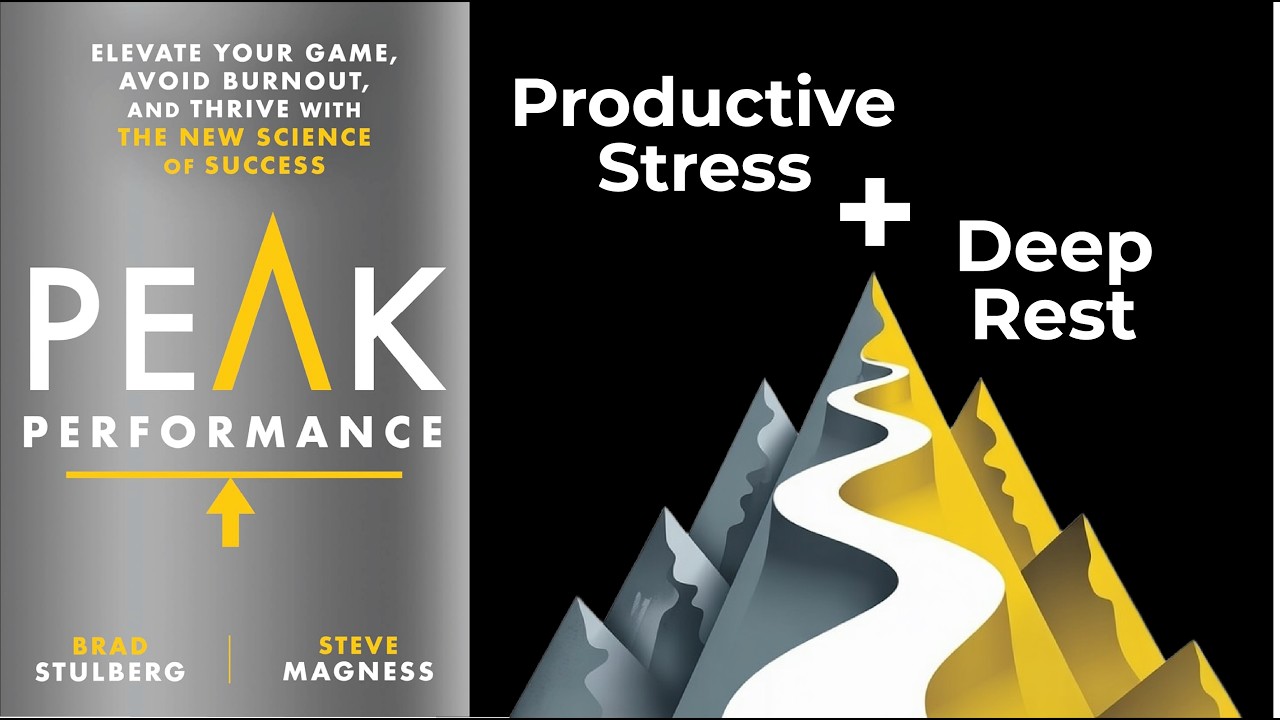
Feeling stuck despite putting in the hours? The key to significant improvement lies in understanding the powerful equation driving peak performers: Productive Stress + Deep Rest = Growth. This principle, distilled from the book Peak Performance by Brad Stulberg and Steve Magness, reveals why many people plateau while others achieve remarkable results.
The Stagnation Trap vs. The Growth Zone
Consider two contrasting approaches:
The Plateau Pattern (e.g., Rick)
Characterized by moderate levels of effort ("productive stress") that never push boundaries, coupled with inadequate recovery ("deep rest"). This combination keeps individuals perpetually within the zone of minimal improvement. Imagine someone wearing a weighted vest all day yet staying up late passively watching TV.
The Peak Performance Pattern
Marked by significant periods of intense, focused effort followed by periods of genuine, restorative rest. The amplitude between these high peaks of stress and deep valleys of rest directly correlates with daily growth. This resembles a powerlifter's focused training session followed by ample sleep.
If your progress has stalled, it's likely because your stress wasn't challenging enough and your rest wasn't sufficiently restorative.
Defining Productive Stress
Not all stress is beneficial. Productive Stress is distinct:
- Acute: Short bursts, typically lasting no longer than 90 minutes.
- Singular: Directed at one specific objective at a time.
- Highly Focused: Free from distractions.
- Challenging: Pushing you to the outer edge of your current capabilities.
A single hour of true productive stress, followed by proper rest (not mere distraction), can yield more progress than days of scattered effort.
Amplifying Focus: The Peak Performance Portal
Don't wait to feel focused; cultivate it deliberately using a structured pre-work routine – a "Peak Performance Portal."
1. State Selection
Before starting, ask: "What state of mind does this task demand?" Peak performers consciously shift their internal state to align with the work. Examples include:
- Reading inspiring non-fiction to spark creativity before writing.
- Listening to motivating poetry or speeches (like Kipling's "If") to foster ruthless precision for editing.
- Assuming a confident posture and recalling past successes to cultivate calm authority before a difficult conversation.
This deliberate shift amplifies the energy needed for deep focus.
2. Consistent Focus Cues
Reduce cognitive load by making your environment familiar and predictable. Aim for consistency in:
- Place: Use the same location (e.g., the same table at a coffee shop).
- Sensory Input: The same background noise (or silence via headphones), the same playlist (some authors even use one song on repeat), the same beverage.
- Tool: Dedicate a specific device or setup for deep work sessions.
This consistency trains your brain to associate these cues with intense focus, minimizing distractions.
Identify Peak Hours: Ask yourself: "If my life depended on taking a demanding test daily, when would I schedule it?" Schedule your most challenging work during these optimal cognitive windows.
3. Purpose Priming
Humans are wired to push harder for others. To boost motivation and prevent burnout:
- Spend 30 seconds before work visualizing who benefits from your effort.
- Recall how much they appreciate your exceptional work.
- Revisit this purpose-driven feeling whenever energy wanes during the session.
Achieving Deep Rest
Recovery is crucial. Between intense work sessions, the goal is simple: Stop thinking about work. Avoid common pitfalls like checking email or scrolling social media, which inhibit neural recovery.
- Mental Work Requires Rest Too: Just like muscles grow during rest after physical exertion, your brain processes learning and sparks creativity during downtime.
- Mindful Activities: Engage in tasks requiring zero cognitive effort while staying present: walk focusing on your breath, wash dishes feeling the water, listen to music with closed eyes.
- The Skill of Presence: Practice dropping intrusive work thoughts, much like dropping thoughts during meditation, and return your attention to immediate sensations.
Companies like Google invest heavily in mindfulness training not just for well-being, but because it fosters consistent innovation – demonstrating the tangible ROI of deep rest.
Putting It Into Practice
Implement the equation with this tactical approach:
- After a 50-90 minute focused work session, rest for at least one-third of that time (e.g., 17-30 minutes).
- Put your phone away. Engage in truly mindless activities.
- Consciously drop work-related thoughts when they arise.
Maintaining this 3:1 ratio of stress to rest consistently over time is the practical key to unlocking significant growth in your career, craft, or sport.
Core Insight:
Sustained peak performance isn't about relentless effort; it's the strategic alternation between periods of intense, focused challenge and periods of genuine, distraction-free recovery. Mastering this rhythm is fundamental to achieving breakthrough results.
 Why China's Semiconductor Industry is Confidently Pushing Forward Without Nvidia Chips
 How to Win When AI Changes Everything: Key Insights from Sam Altman
 Unlock Breakthrough Growth: The Peak Performance Equation Revealed
The Unconventional Genius Behind Linux: Linus Torvalds on Quiet Focus and Engineering Excellence
Unlock Breakthrough Growth: The Peak Performance Equation Revealed
The Unconventional Genius Behind Linux: Linus Torvalds on Quiet Focus and Engineering Excellence
 How Chinese Colour Theory Revolutionized My Artistic Approach
 Is China Heading Toward a "Lost Decades" Scenario? Deflation, Property Crisis, and Consumer Gloom
 Mastering Social Media Marketing: Your Comprehensive Guide to Building Brands and Boosting Sales
 How to Change Minds: Why Facts Alone Fail and What Actually Works
 Cloudflare Outage Reveals Fragility of Modern Internet Infrastructure
 David Heinemeier Hansson: Programming, Ruby on Rails, and Life Beyond Code
 Sam Altman Unveils GPT-5: Capabilities, Future of AI, and Societal Impact
 Building a True MVP: How to Launch Fast and Validate Your Idea
 Inside OpenAI's $500 Billion Stargate: The AI Megafactory Reshaping Tech and Society
 China's Mountain-Split Bridge: Engineering Triumph in Guizhou's Highlands
 Sam Altman Unveils GPT-4's Breakthroughs and AGI Roadmap
 The Xiaomi SU7: A Glimpse of What We're Missing — And Why
 Europe's Strategic Blind Spot: Why China Views the Continent as Invisible
 Does OpenAI's Sora Disrupt Meta? Analyzing the Shift in AI-Driven Content Creation